Talking point: Housing the world
02.12.25
Rory Olcayto
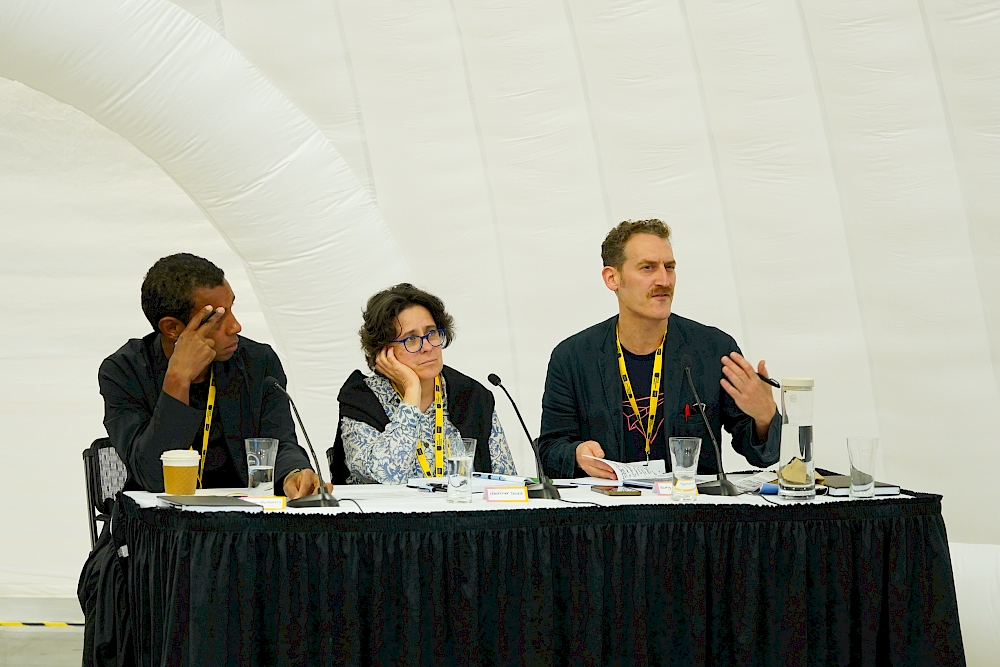
The day was long. Eight hours of crits and feedback after a ten-hour flight could scramble anyone’s brain, but the projects I reviewed with my fellow judges, both architects - Heather Dodd (chairing) from South Africa and Jamaica’s Kevin McMorris - were mostly bangers.
We’re talking WAF 2025 - the world’s largest live-judged architecture awards - which this year took place in a vast conference centre in Miami Beach. Heather, Kevin and I were judging the housing category, and by the day’s end, two schemes had pulled ahead of the pack: both social housing, one Spanish, the other American, both pretty exceptional. First up, the runner up: Urbanitree’s Terrazas para la vida, providing 40 homes in Barcelona, its mass-timber CLT frames and ground-floor fab-lab, a perfect expression of the Catalan capital’s pace-setting urbanism, and keyed into a national vision of new forestry and housing as infrastructure that all of us should be vying to replicate.
Unbelievably, given they used shipping containers (mere mention of them should usually be enough for a juror to cry, ‘Next!’) Ghazal Khezri with Geoffrey Sorrell – of LA practice Lorcan O’Herlihy – went one better with Isla Intersections, to grab the housing category gong (it would go on to land WAF’s American Beauty Prize too.)
The project occupies a tight polygon of land under the tangled concrete shoelace of the 110–105 interchange in South LA. The lead designer, Ghazal, formerly of Coop Himmelb(l)au, has placed 54 dwellings for once-homeless people (with ten for army vets) alongside one of the world’s busiest roads, using stacked shipping containers painted a stark ranch white and deploying, to my Gen X eyes, a rather DeCon plan. Unsurprisingly, Peter Cook, leading the supercrit jury on the final day, “loved it.”
This sculptural composition sweeps down to street level, opens up a central courtyard and fashions a new paseo, a walkable green street with space for retail and workshops. Despite the hard metal aesthetic, it’s a gentle response in a brutal context and while its true none of the jury had actually been there, we all sensed, like a rabbit from a hat, it made a proper place out of nothing.
Despite the hard-metal aesthetic, it’s a gentle response in a brutal context. It had a kind of ferocious friendliness I felt. Whatever, its sheer verve left the jury reeling. Here was a project that makes you believe buildings - and architects - can fix things.
There were other impressive works to contend with: Safdie Architects impossibly vast Habitat Qinhuangdao (in terms of scale, an elephant to Park Hill’s gnat) on China’s northeast coast. It’s a properly three-dimensional neighbourhood housing some 5,000 people and featuring 16 storey blocks, community amphitheatres and no double-loaded corridors. But the presenters didn’t show a plan, or what the homes were like inside.
There was a Parisian housing scheme, for Chinese students, that blended two housing types: the ‘tulou’, a traditional circular community residence from southern China, and the Haussmann block to form something both familiar and new, which is pretty much what you want when you’re a student in a far-off land.
There were other interesting schemes. Retrofit projects in Shanghai revitalising relics in the city’s historic French concession. Luxury homes in Lima drawing on the Huaca adobe vernacular. Key worker homes in Bangkok, taking façade design seriously as a building block for urban identity and a huge mixed-use scheme in Kyiv, with shades of Bofill, but memorable mostly for its stop-start war-time construction, including enduring a huge missile strike in the summer just past.
In the end, what really impressed at this year’s WAF were the schemes that quietly stitched life back into their cities. The housing in Barcelona and South LA was streets ahead of what we’re doing here, with our bricks, SuDS and cycle stores. If there’s a message for the UK, it’s hardly deep: look beyond the brick slip, clock what’s happening across the water, and nick the best, most ambitious ideas to bring home.